Buyers evaluating stretch fabric for children's swimwear get handed a lot of adjectives: soft, premium, high-recovery, competition-grade. None of them are testable. The useful conversation starts when a supplier can quote three numbers — weight, stretch direction and recovery — and explain how they were measured.
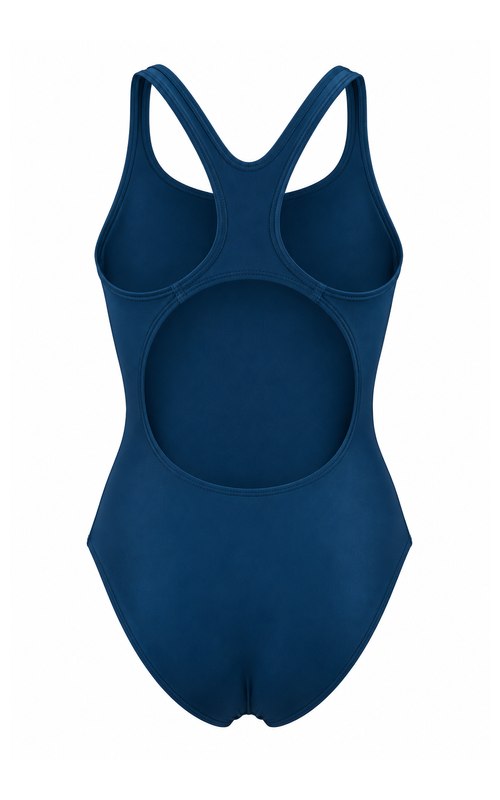
This guide covers the specs worth putting in a tech pack, using benchmarks from published stretch-fabric guidance for dancewear and gymnastics, and explains where those benchmarks do and do not transfer to swimwear.
Weight (gsm): the number that predicts most complaints
Fabric weight is grams per square metre. For stretch knits used in fitted performance garments, published guidance puts the practical working range at roughly 180–240 gsm.
Outside that band, the failure modes are predictable:
- Below about 160 gsm the knit is prone to going sheer when stretched over a hip, shoulder or seat — which on children's swimwear is exactly where it matters. It also tends to lose shape faster.
- Above about 260 gsm the fabric starts to restrict movement and trap heat. On a child in a pool that reads as "too stiff to swim in", even if the garment fits.
Two practical notes. First, small weight differences inside the band — 210 versus 225 gsm — are imperceptible to a wearer; do not spend a sampling round chasing them. Second, a heavier fabric is not automatically more durable. Weight and recovery are separate properties, and a heavy knit with poor elastic memory will still sag.
Stretch recovery: the spec that decides whether it sags
Recovery measures how much a fabric returns to its original length after being stretched. The standard way to assess it is to extend a sample to 100% and measure return after a defined interval — commonly 30 seconds.
Published guidance for performance knits treats 92% or above as acceptable, with below 88% producing visible sag within about ten minutes of wear. For competitive or high-hours use, the recommendation moves up to 94% or above.
Why this matters more on children's swimwear than on adult swimwear: a child's garment is repeatedly pulled on and off wet, stretched over hips and shoulders that are proportionally wider relative to torso length, and worn in chlorinated water. A knit at 86% recovery will look acceptable on the sample table and bag out at the seat after a few wears — and the brand gets the complaint, not the mill.
Stretch direction: four-way is not optional
Two-way stretch extends horizontally but not vertically. On a fitted one-piece this shows up as a garment that accommodates width but fights length — the shoulder pulls, the leg opening rides, and the torso does not follow the body through a reach or a kick.
You can check this cheaply before ordering: pull the swatch diagonally. It should extend comparably in all directions and return. If it resists or distorts, no amount of pattern correction compensates — the fabric is wrong for the style.
Sheerness and opacity
Opacity is not a fixed property; it changes with stretch and with colour. A white or pale knit that looks opaque flat will often go translucent at 30% extension. Because children's swimwear is worn wet and stretched, opacity should be assessed on the stretched fabric in the intended colour, not on a flat swatch in a different colourway.
The practical test is a visual check over a contrasting surface at the extension the garment sees at the hip and seat. Ask for it on bulk fabric, not the sample.
Where these benchmarks come from — and where they stop
An honest note on sourcing. The 180–240 gsm band, the 92% / 88% recovery thresholds and the four-way rule are published benchmarks for dancewear and gymnastics knits, where the same nylon-spandex family is used. They are a sound starting point for children's swimwear because the mechanical demands overlap.
They are not a swimwear standard. Swimwear adds requirements those benchmarks do not cover:
- Chlorine exposure. Pool water attacks elastane over repeated cycles. A knit that passes recovery testing dry may degrade faster in chlorinated use. Ask specifically about chlorine resistance and what evidence supports the claim.
- Colourfastness to chlorinated water and salt water — a separate test from wash fastness.
- Lining. Children's swimwear is usually lined at the front; lining weight and opacity interact with the shell fabric and need to be specified together.
Treat the published numbers as a floor for mechanical quality, then add the swim-specific tests on top.
What to write in the tech pack
- Fibre content as percentages — "nylon 80% / elastane 20%", not "nylon blend"
- Weight in gsm, with a tolerance (for example ±5%)
- Stretch direction: four-way, stated explicitly
- Recovery percentage, or the test method and acceptance threshold
- Opacity requirement at hip and seat, assessed on stretched fabric
- Colourfastness requirements for chlorinated and salt water, separately
- Lining specification, including its weight and opacity
- Chlorine resistance claim, if any, with the evidence that supports it
If a supplier cannot state gsm or recovery, that tells you how tightly they control their fabric — not just that an answer is missing.
How we specify fabric at Naditas
We make children's swimwear in nylon-spandex and polyester-spandex knits on the same stretch lines as our rash guards and girls' swimwear, with children's pattern grading throughout. At enquiry we ask for fibre content, weight, stretch direction and lining specification, and we ask what chlorine-resistance evidence exists if a client intends to make that claim.
Where a mill cannot confirm a figure, we say so rather than quoting a number to close a conversation. The fabric decisions behind our dancewear range are set out separately in our cotton versus nylon spandex guide.