Most kids leotards on the market are made from one of two blends: a cotton-rich knit (typically 92–95% cotton with 5–8% elastane) or a nylon-spandex knit (commonly 80/20 or 75/25). They are not interchangeable, and the choice changes how the garment behaves after ten washes, how it reads under studio lighting, and what it costs you per unit.
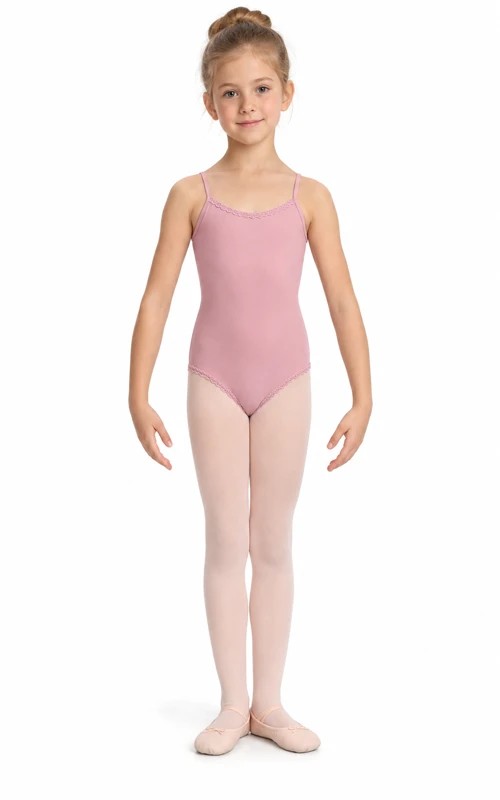
This guide sets out what each blend is for, where the industry disagrees, and what to specify in your tech pack so the factory cannot substitute one for the other.
What each blend is actually for
Cotton-spandex is a comfort fabric. The natural fibre breathes, feels soft against the skin and holds dye evenly in solid colours. It is the classic choice for daily ballet class and exam wear, where the leotard is worn for an hour or two, washed constantly, and needs to feel unobtrusive.
Nylon-spandex is a performance fabric. It has tighter stretch recovery, dries faster, resists pilling from mat friction, and keeps its colour depth through repeated washing. It is the standard for competition, gymnastics and any programme with high weekly training hours.
Both are legitimate. The mistake is buying one and expecting the behaviour of the other.
Where the industry genuinely disagrees
Search for buying advice on leotard fabric and you will find two positions that flatly contradict each other. One camp, writing for makers and home sewers, states plainly that cotton blends should be avoided for gymnastics because they lack recovery and wick poorly. Another camp, writing for dance retailers, sells cotton-spandex as the exam-approved, studio-standard choice and lists breathability and softness as its core advantage.
Both are correct within their own scope, and that is the useful part for a buyer:
- The anti-cotton position is written about gymnastics — inverted skills, apparatus friction, long sessions. Recovery matters more than softness there.
- The pro-cotton position is written about ballet class and exams — upright posture, short sessions, daily washing, and a dress code that rewards a matte, uniform look.
So the question is not "which fabric is better" but "which programme is this leotard for". A gymnastics club buying practice wear and a ballet school buying class uniform should not be specifying the same knit.
Side-by-side on the specs that matter
- Stretch direction. Nylon-spandex is reliably four-way. Cotton-spandex can be two-way or four-way depending on the knit structure — and two-way fails in splits and oversplits. If you order cotton, specify four-way in writing.
- Stretch recovery. This is the single number most worth asking for. Recovery measures how much the fabric returns to its original length after being stretched. Industry guidance puts acceptable performance at roughly 92% or above; below about 88% the garment visibly sags within minutes of wear. Nylon-spandex generally tests higher here.
- Weight. Leotard knits commonly sit in the 180–240 gsm band. Below roughly 160 gsm the fabric can go sheer when stretched over a hip or shoulder; above roughly 260 gsm it starts to restrict movement and trap heat. Cotton-spandex jersey tends to run heavier than nylon-spandex for the same coverage.
- Opacity. Cotton blends can thin at stress points after repeated washing. Ask for an opacity check on the bulk fabric, not the sample.
- Colour. Nylon takes dye with more depth and holds saturation better; cotton gives an even, matte solid. If your range is built on brights and neons, nylon will hold them longer. If it is built on muted studio tones, cotton is fine.
- Chlorine and pool exposure. Nylon-spandex is the more chlorine-tolerant of the two. Cotton absorbs and holds water, which makes it a poor choice anywhere the garment is worn in a pool.
What to put in your tech pack
Vague fabric descriptions are how substitutions happen. Specify these six items and you remove most of the ambiguity:
- Fibre content as a percentage range, not a name — "cotton 93% / elastane 7%", not "cotton blend"
- Weight in gsm
- Stretch direction (four-way) and, if you can get it, recovery percentage
- Opacity requirement at the hip and shoulder
- Colour reference — Pantone TCX for solids, or a strike-off for prints
- Wash-test requirement and the number of cycles before approval
If a supplier cannot state the gsm or the recovery figure, treat that as a signal about how precisely they control their fabric, not just an incomplete answer.
How this plays out in a real range
Experienced buyers often run both blends in one collection rather than picking a side. A typical split looks like this: cotton-spandex for the class and exam leotards that parents buy repeatedly in core colours, and nylon-spandex for competition pieces, performance styles and anything with mesh, foil or print that needs to hold its shape on stage.
That structure also solves a merchandising problem. The cotton line carries the volume at a lower unit cost and a wider colour range; the nylon line carries the margin and the brand story.
How we handle both at Naditas
We make leotards in both blends on the same stretch-fabric lines as our kids' swimwear, with the same children's pattern grading and private-label service. Our gymnastics and dancewear range currently includes cotton-spandex camisole practice leotards and nylon-spandex competition styles, so you can compare the two directly rather than working from a swatch card.
We ask for fibre content, weight and stretch direction at the enquiry stage, and confirm them against the approved sample before bulk production. Where a spec cannot be confirmed with the mill, we say so rather than assuming it.