Reusable swim diapers are one of the few baby categories where the purchase is almost entirely practical. Nobody buys a swim diaper for fashion — they buy it because the pool requires one, the beach trip needs one, or swim class won't take their baby without one. That makes the category remarkably steady: parents replace them as babies grow, swim schools order them in bulk, and retailers reorder every season. It is also a low-risk first SKU for a brand entering baby swimwear — small pattern pieces, one main construction, and a clear function that is easy to explain on a hangtag.
The catch is that most returns and complaints in this category come from one misunderstanding: what a swim diaper actually does. Get that right in your product pages, and most of the rest takes care of itself.
What a swim diaper actually does (and doesn't)
A swim diaper does not absorb. Regular diapers swell up and become useless within minutes in water; a swim diaper is built to contain solids — nothing more. It keeps the pool water clean, but it will not keep a baby dry and should never be sold as a substitute for a regular diaper.
This distinction matters for two practical reasons. First, pools and swim schools require swim diapers precisely for containment — your customers are buying compliance. Second, disappointed parents who expected absorption are the main source of bad reviews in this category. A hangtag line like "contains solids, does not absorb — change after swimming" prevents most of those complaints before they happen.
Pull-up vs snap styles: what retailers actually stock
Swim diapers come in two main constructions, and the difference decides who your buyer is:
- Pull-up style: elastic waistband and elastic leg openings, pulled on like little swim trunks. Quick to change, trim under a swimsuit, and the style most swim schools and pools are used to seeing. This is the construction we build our range on: no snaps to fail, no hardware against the baby's skin.
- Snap-closure style: snaps or velcro at the sides or waist. Easier to remove when soiled without pulling down, which some parents prefer — but snaps add a hardware point that must pass pull-strength testing, and velcro collects sand and lint.
For wholesale buyers, pull-up is the simpler product: fewer components, fewer failure points, and one consistent fit story across sizes. Whatever style you choose, check elastic recovery — elastics that go slack after a few swims are the number-one complaint in this category. Ask how the factory tests it, not just what it's made of.
Fabric and lining: the checklist that matters
The fabric spec decides whether a swim diaper lasts a season or a summer:
- Outer fabric: polyester/spandex or nylon/spandex swim knit — the same family as swimsuit fabric, so it handles chlorine and salt water. UPF 50+ rated knits add a real selling point for outdoor use, and the factory should be able to provide the lab test report for the bulk fabric.
- Lining: a soft mesh or performance liner inside, so the diaper breathes and doesn't cling. The liner is what touches the baby's skin all day — it should be smooth, with flat seams.
- Seams: flatlock or clean overlock stitching. Bulky seams chafe, and chafing on a baby means the product gets returned regardless of how cute the print is.
- Skin safety: for anything worn by babies, ask for OEKO-TEX Standard 100 certified fabrics. It is the certification baby buyers ask about most, and it answers the "is it safe on newborn skin?" question before it is asked.
Sizing: weight first, age second
Babies of the same age vary enormously, so age-only sizing is the main cause of fit complaints. A size chart that lists weight ranges alongside age — and gives finished waist and thigh measurements — cuts returns dramatically. Most ranges run from newborn/small (roughly 3–6 kg) through large/toddler (roughly 11–14 kg), with size steps following the baby's growth curve, not round numbers.
One practical note for buyers: a swim diaper should fit snugly at the waist and thighs. Parents used to roomy regular diapers often size up, and then complain about leaks. Your size chart and product copy should say plainly: "should fit snug — if in doubt, size down, not up." Retailers who print that line report fewer exchanges.
Prints and private label
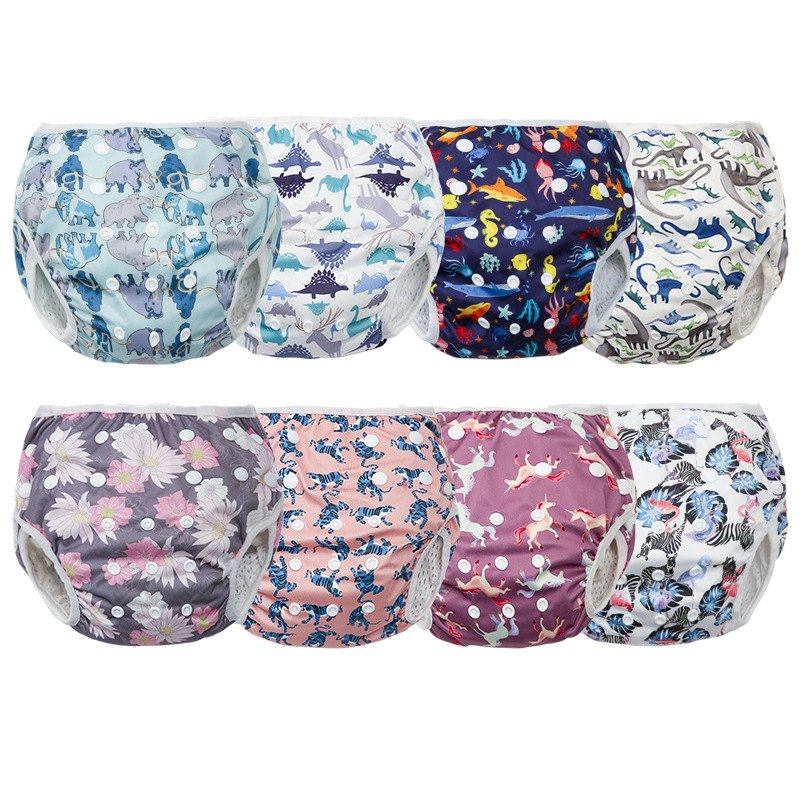
Swim diapers are one of the easiest baby products to private-label, because the whole product is essentially one printable surface. All-over sublimation prints — the small fish, flamingo, floral and ocean patterns parents recognize — hold up well to chlorine and sun on the right polyester knit. Our own range runs one print per SKU, which keeps inventory clean: each design is its own item, its own listing, its own reorder point.
For custom prints, the order matters: confirm the artwork, approve a strike-off (a printed fabric swatch) before bulk, and only then cut. A factory that skips the strike-off to save a few days is the one most likely to deliver the wrong shade of blue on 2,000 pieces. Sampling for swim diapers typically runs 7–10 days — short enough to do this properly.
What to ask your factory before ordering
Swim diapers look simple — which is exactly why buyers should verify the basics before ordering. Get clear answers on:
- Minimum order: our MOQ is 100 pieces per style per color — low enough to test a print before committing to a full range.
- Sampling and bulk lead times: 7–10 days for samples, 25–40 days for bulk production. Build your season backwards from these numbers.
- Quality system: we inspect to AQL 2.5. Ask any factory what standard they inspect to — a factory that can't name its AQL is telling you it doesn't have one.
- Elastic and snap testing: how is elastic recovery verified, and are snap pull-strength tests done per batch?
- Certifications: BSCI for the factory, OEKO-TEX for baby fabrics, GRS if you sell recycled lines. Certificates should be current and name the actual factory.
- Responsiveness: we reply with a formal quotation within 24 hours on working days. In sampling season, a factory that takes a week to answer an email will cost you a month on the calendar.
The five questions parents will ask you
Keep ready answers to these on your product pages — they come up constantly:
- "Does it absorb?" — No. It contains solids only. Use a regular diaper underneath on the way to the pool if needed, and change right after swimming.
- "Can my baby wear it without a swimsuit over it?" — Yes. A swim diaper is designed to be worn alone in the water.
- "How do I clean it?" — Rinse in cold water right after use, machine wash gentle, hang dry. No bleach, no fabric softener — both damage the elastic and the water-resistant finish.
- "How long does it last?" — With proper care, a full swim season or more. Elastic fatigue is the normal end of life; when the waist goes slack, replace it.
- "What size should I get?" — Go by weight, not age, and aim for snug at waist and thighs.
How we make swim diapers at Naditas
We manufacture reusable baby swim diapers in our Quanzhou factory — established 2013, 4,000 m², 100+ workers, 80,000+ pieces of monthly capacity. Our diapers are pull-up style with elastic waist and leg openings, UPF 50+ rated fabrics (lab test reports available), and OEKO-TEX certified materials for the baby range. One print per SKU keeps your inventory simple, sampling runs 7–10 days, and bulk production 25–40 days. If you're building a baby swim line, start with our private label manufacturing page — we reply with a formal quotation within 24 hours on working days.