In children's clothing, a cord is not a neutral detail. It is a hazard pathway: something that can catch on playground equipment, a bus door handle or a pool ladder, and transfer force to a child's neck or torso. That is why the European market regulates cords and drawstrings specifically, under EN 14682, rather than leaving them to general product-safety judgement.
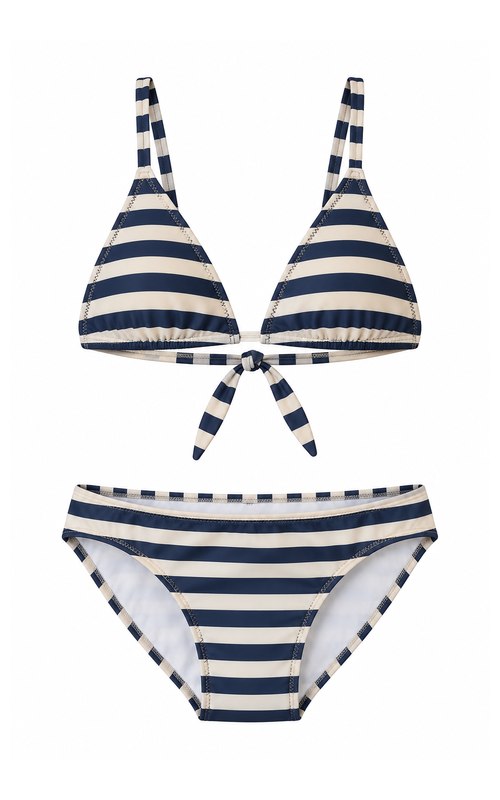
Swimwear is squarely in scope. Tie-back bikinis, halter neck ties, adjustable waist drawcords and decorative bows all involve cords or loops, and all of them need a design decision recorded before the style is approved.
A note on scope before going further: this article explains the framework and the questions to ask. It is not a substitute for the purchased standard text or for a qualified EU product-safety review. Requirements depend on the applicable edition of the standard and on the garment's age category and feature zone — two things no blog diagram can settle for you.
What EN 14682 actually covers
EN 14682 is the European standard for cords and drawstrings on children's clothing. The European Commission published its reference in Commission Implementing Decision (EU) 2015/1345. The standard sets out specifications by feature location and by age group.
Two consequences matter for a swimwear brand:
- It is a design control, not a post-sewing label. You cannot sew a cord on and then test compliance afterwards. The decision belongs at sketch and pattern stage.
- "Drawstring" is not the only item in scope. Decorative cords, ties, functional adjustment cords, loops, elastic cord features and connected hardware all need screening according to the definitions in the standard.
Where cords appear on kids swimwear
A practical screening pass over a swimwear range usually surfaces these zones:
- Halter / neck ties — ties that fasten behind the neck. These sit closest to the highest-risk zone and deserve the most careful review.
- Tie-back fastenings — bows or ties at the centre back or side. The question is whether the free end can be caught, and how much extension it has.
- Waist drawcords — on swim shorts and some one-pieces. Functional, but the free ends and the toggle (if any) both change the hazard profile.
- Decorative bows and ribbon trims — often assumed to be exempt because they are "just decoration". The distinction between a sewn-on decorative detail and a cord or loop covered by the rule is a technical judgement, not an aesthetic one.
- Shoulder straps with adjusters — if an adjuster creates a loop or an exposed free end, it belongs in the review.
The right way to run this is a zone-by-zone screening of the tech pack, recording every cord-like feature — including the ones nobody thinks of as drawstrings.
Age group changes the answer
Children's clothing standards commonly distinguish groups by age or height, and the permitted construction can differ between them. This creates a specific trap for swimwear: a single design sold as "2–14Y" may span two or more regulatory categories.
If that happens, you have two honest options:
- Build the style differently by size group, or
- Choose a universally safer construction that works across the whole range.
What you cannot do is label the style 2–14Y in the tech pack and assume one placement rule covers it. Ask the reviewer to record the age group, the exact clause applied, and why the approved construction is acceptable.
Design out before you test
The first control is always to remove or redesign an unnecessary hazard. In swimwear this is often easier than it sounds:
- A decorative tie that serves no function can usually be deleted outright.
- A functional adjustment can sometimes be replaced with elastic, a fixed gathered panel, or a covered fastening.
- A tie-back can often become a fixed bow with short, sewn-down ends.
Selecting the safer design at sketch stage costs nothing. Cutting cords off finished garments costs a production run. A useful sample-room conversation asks: why does this cord exist, is the function essential, what is the child's age and activity context, can the adjustment be achieved without exposed ends or loops, and which clause and documented sample confirm acceptance?
EN 14682 is not the whole compliance picture
This is the point most often missed. EN 14682 addresses one class of mechanical hazard. The EU General Product Safety Regulation imposes broader duties — risk assessment, traceability, and action on unsafe products. A garment can pass the cord question and still fail a chemical requirement, carry inadequate traceability, or present a different hazard entirely.
Equally, a supplier should not claim "EU certified" because a design was reviewed against a standard. The defensible statement names the specific requirement, the product, the assessment date, the evidence and the responsible party.
What to document, and keep
For each cord feature, a decision record should carry:
- Style code and the reference sample ID, revision and date
- Target market and the age group / size range covered
- The feature zone (neck, back, waist, hem, shoulder)
- The applicable standard edition and the specific clauses applied
- The observed measurement or construction, and how it was verified
- The decision — accept, revise or block — and who signed it
Keep the approved physical sample at the line and at final QC. If production changes the cord material, the locking mechanism or the cut length after approval, the review reopens. That last rule is where most factory-side failures originate: the sample was compliant, the bulk run quietly was not.
How this applies to our own range
Several styles in our girls' swimwear range use tie-back fastenings and bow straps, and our float swimwear and swim shorts use adjustable waist cords. We treat those as regulated features, not styling: the cord zones are flagged at tech-pack stage, and where a client is selling into the EU we ask them to confirm the applicable age category and clause with their own compliance reviewer before we cut.
Where we cannot confirm a requirement, we say so. A factory that answers every compliance question confidently, without asking which edition of the standard applies, is telling you something about how it handles the ones you did not ask.